
Keyless entry lets a business give each employee or tenant their own way in and take it away without rekeying. The right choice depends on the door, how many people use it, and how much control you need over who gets in and when.
Jose M. Hernandez Jr., owner of Omega Locksmith in Chicago, explains the main types of commercial keyless entry, the hardware behind them, and what to decide before you buy. Omega focuses on single-door systems: a front entrance, employee door, stockroom, office or medical suite.
Option 1: Standalone keypad locks
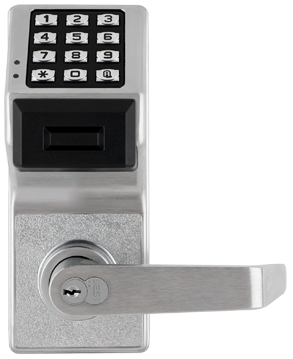
A standalone keypad lock replaces the keyed lever or deadbolt with a keypad. Codes are stored in the lock and usually managed at the door or with a programming tool. Most run on batteries, so no wiring is needed.
Common commercial examples include the Alarm Lock Trilogy series, the Marks i-Qwik line and Simplex mechanical pushbutton locks, which need no batteries at all.
Use individual codes, not one shared code. With one code for everyone, you cannot tell who came in, and when one person leaves you have to change it for all. With individual codes, you delete one code and everyone else keeps theirs.
Option 2: Card and key-fob readers
A reader next to or on the door unlocks it when an authorized card or fob is presented. A manager issues and removes credentials, and many systems keep a log of entries. Readers usually work with an electric strike or electrified lock and need power, so the door, frame and wiring path must be checked first.
Option 3: Phone and app-based locks
Some commercial locks open from a phone app and let you manage users remotely. They depend on the app, the manufacturer’s service and a network connection, so plan who will administer it and what happens if the connection goes down. Read are smart locks safe for Chicago businesses before choosing one.
The locking hardware: electric strikes and magnetic locks
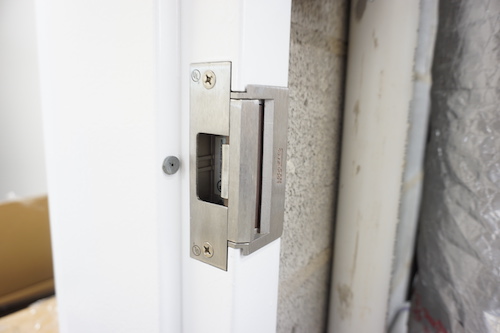
- Electric strike: replaces the strike plate in the frame and releases the latch on command. The lock on the door still works mechanically.
- Magnetic lock: holds the door shut with a magnet. It releases when power is cut, so it needs a code-compliant way to exit and careful planning.
Electrified hardware is either fail-safe, meaning it unlocks when power is lost, or fail-secure, meaning it stays locked when power is lost and unlocks only when power is applied. Which one is right depends on the door, fire and life-safety requirements, and what you need to happen during a power outage. People must always be able to get out; see panic bars and exit devices.
Features worth asking about
- Individual user codes or credentials.
- Scheduled unlock (passage mode) during business hours.
- An entry log you can actually review.
- Automatic relock after each entry.
- A mechanical key override for dead batteries or power failures.
- A weather rating for exterior doors facing Chicago winters.
- Low-battery warnings.
One door or a whole building?
Many businesses only need control at one or two doors, and a standalone keypad or single-door reader is a practical fit. Networked systems that run many doors from central software are usually designed by an access-control integrator. If you are not sure which you need, describe the doors and users and we will tell you whether a single-door solution fits.
If your main concern is people copying keys rather than going keyless, a CX5 restricted-keyway system may solve it at lower cost. For buildings with many users at different levels, compare with a master key system.
Before you call
- Which door, and photos of both sides, the frame and the current lock.
- Whether the door closes and latches on its own.
- How many people need access and how often that changes.
- Whether you need entry logs or schedules.
- Whether there is power near the door.
Related reading: commercial locksmith services guide, door lock types and warning signs your commercial door needs attention.
Omega Locksmith is located at 4346 W 51st St, Chicago, IL 60632. Owner Jose M. Hernandez Jr. holds individual Illinois locksmith license 191-000821. Call (773) 277-5625 or see our access control service.